

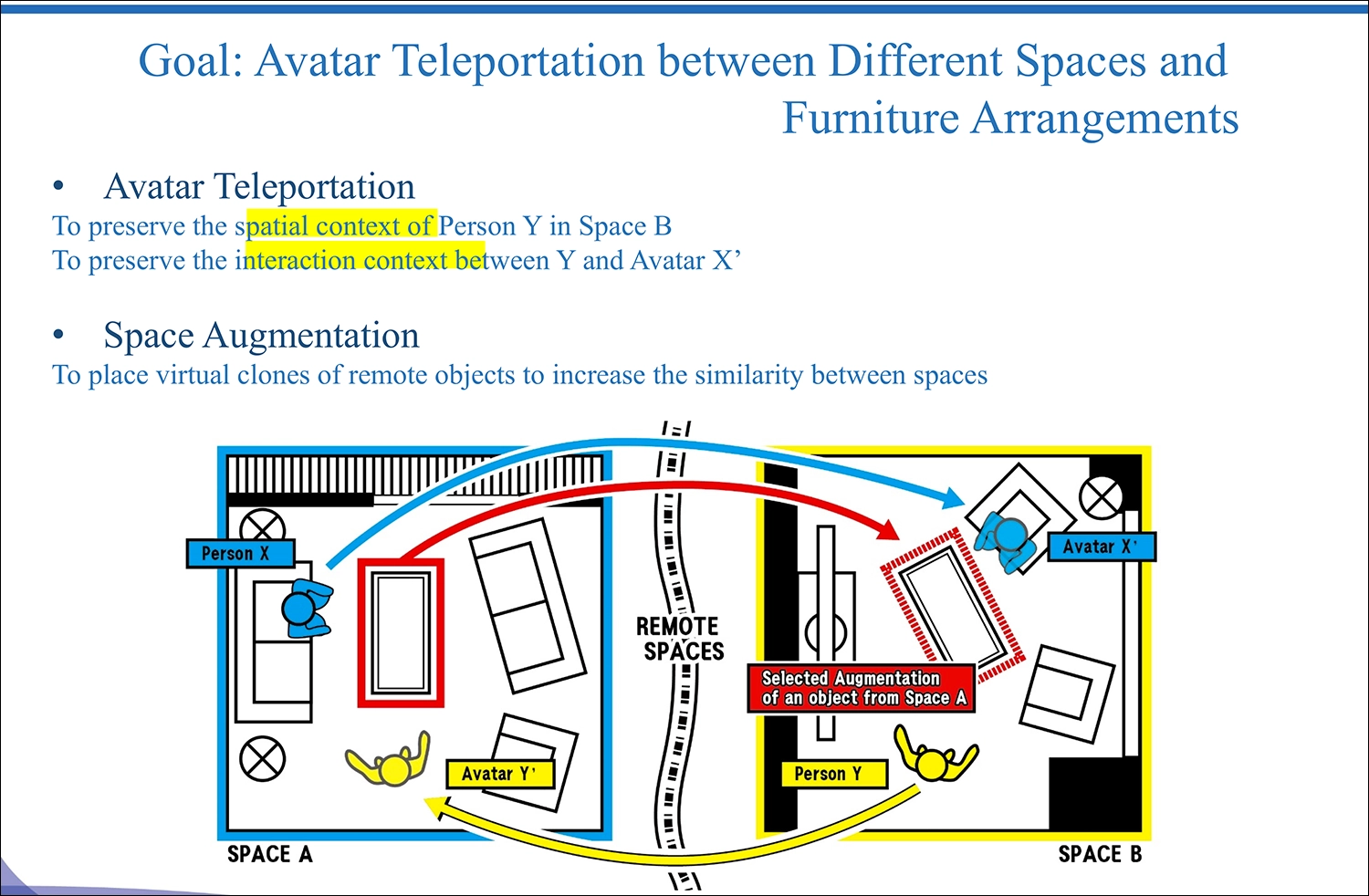
Study on Motion Adaptation for Telepresence Avatars in Dissimilar Remote Spaces
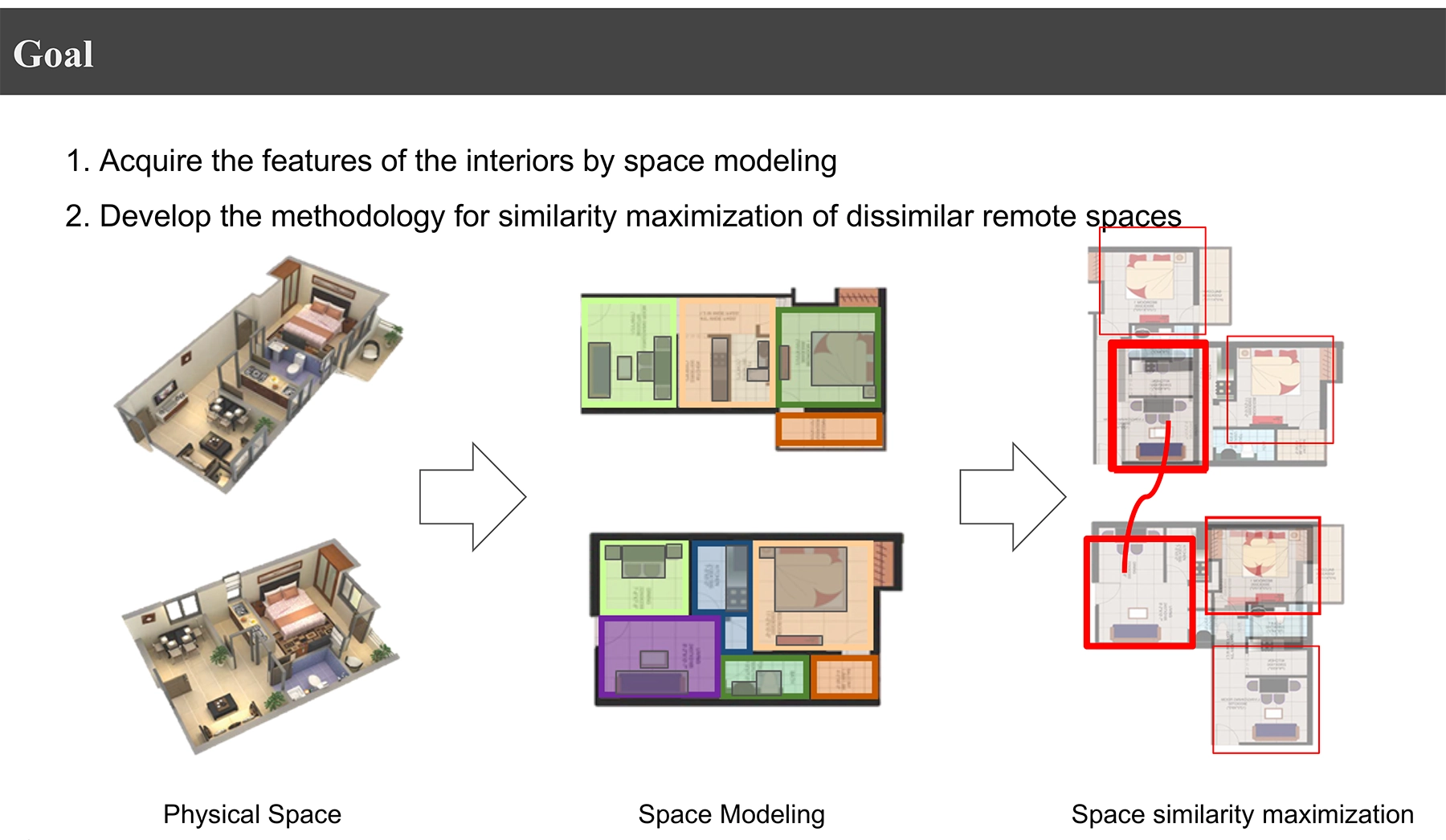
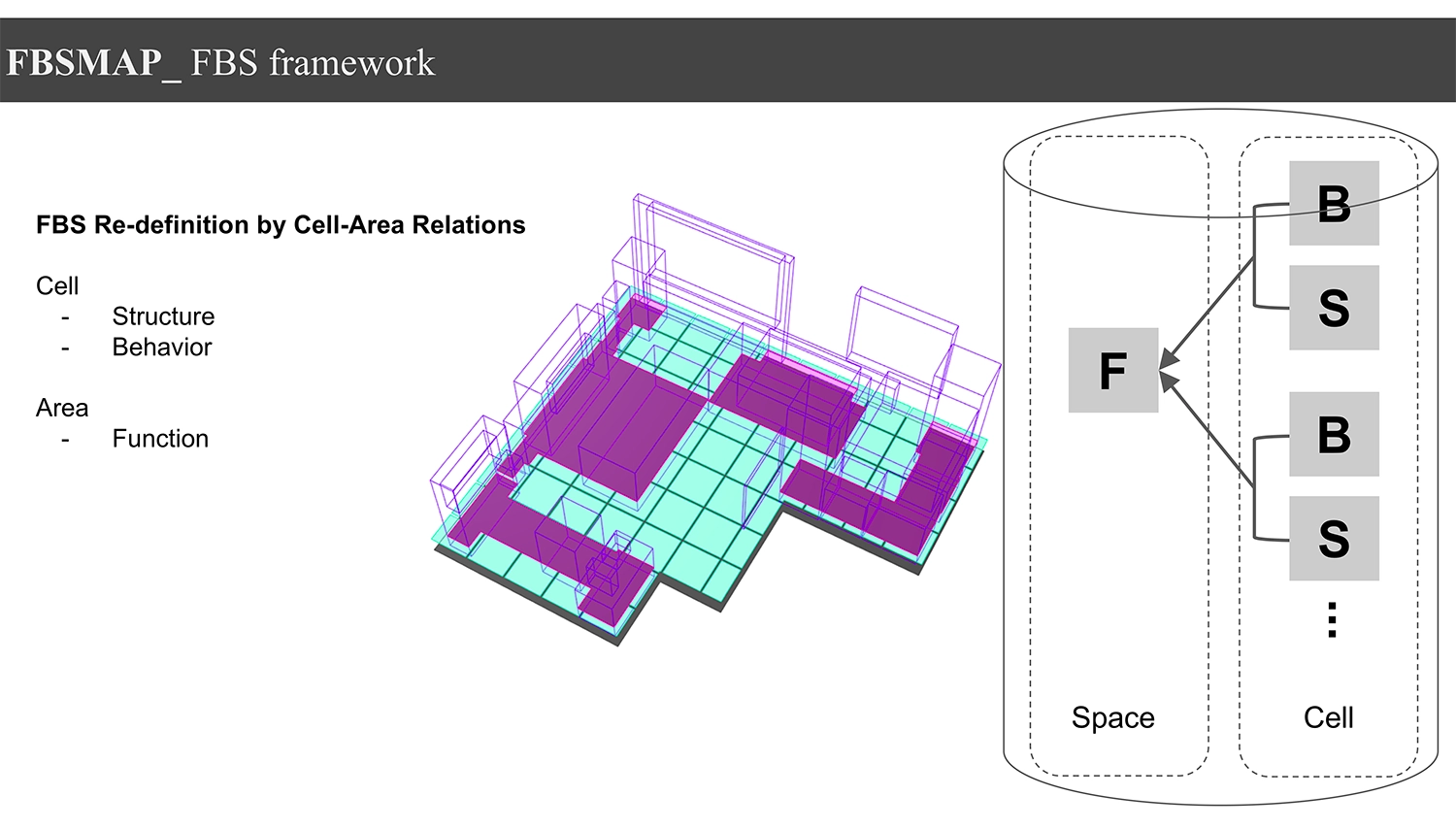
In order to provide intelligent services in an indoor environment at furniture level, it is important to understand not only the physical attributes but also the semantic features of an interior space. Spatial similarity measurement is a comparison method conducted on top of a hierarchical graph representation to calculate numeric values considering quantified spatial features. Three consecutive tasks are required: indoor space modeling, user study acquiring spatial context, and spatial similarity calculation. To evaluate the effectiveness of the method, a comparison was made
with the existing random sampling method. The findings surpassed the random sampling results in four experimental cases. Spatial similarity measurement is therefore capable of analyzing the spatial context with proposed similarity criteria and equations, and it also suggests the probability of local similarity of a functional space.
Publications
Hong, S., Chang, M., Dwivedi, U., Porcellini, V., Lee, C. S., & Lee, J. H. (2020). Spatial Similarity Measurement in Dissimilar Indoor Environments Using Semantic Features for Virtual Space Services. 융합연구학회지, 4 (1), 93-110.
Dwivedi, U., Porcellini, V., Hong, S., Chang, Z., & Lee, J. H. (2019). Computing Spatial Features to Allocate Collision-free Motion-paths for Tele-presence Avatars. Proceedings of the 24th International Conference of the Association for Computer-Aided Architectural Design Research in Asia (CAADRIA) 2019, 1, 245-254.